
The Copper Mine National Park, Virgin Gorda.
The BVI’s National Parks Trust was established in 1961. Its original purpose was to manage the Sage Mountain Park but over the years its responsibilities have increased to overseeing and managing over 20 national parks. The work of the Trust also includes species restoration (the pink flamingoes and endemic rock iguana), marine conservation, reforestation, historical preservation of which the copper mine ruins is one, biodiversity research and conservation as well as youth environmental education.


The Copper Mine ruins are on Virgin Gorda’s south-east point. The site was officially designated a national park in 2003. The early history of the mine is doubtful. It is rumored that Amerindians used copper from the site but this is likely false. Local lore says that the Spanish were the first to mine copper here but there is no evidence of this either, just as there is no evidence of the Spanish ever having settled in Spanish Town. It is more likely that the town was named for an estate owner named Penniston. It would have predated the town’s rise to prominence and was part of the patchwork of British colonial landholdings in the Virgin Islands. The estate name gradually faded as Spanish Town became the dominant name in the 19th century. Interestingly, Spanish Town was the capital of the territory until 1741 when it was moved to Road Town in Tortola.
There is no doubt that the British built the mine and began mining operations in or around 1837. The operation was registered as the Virgin Gorda Mining Company and used Cornish miners and British capital. During its heyday the mine employed about 30 experienced Cornish miners and approximately 120 Afro-Caribbean labourers. The mine operated until 1862, ceasing due to escalating costs and other logistics including declining copper prices.
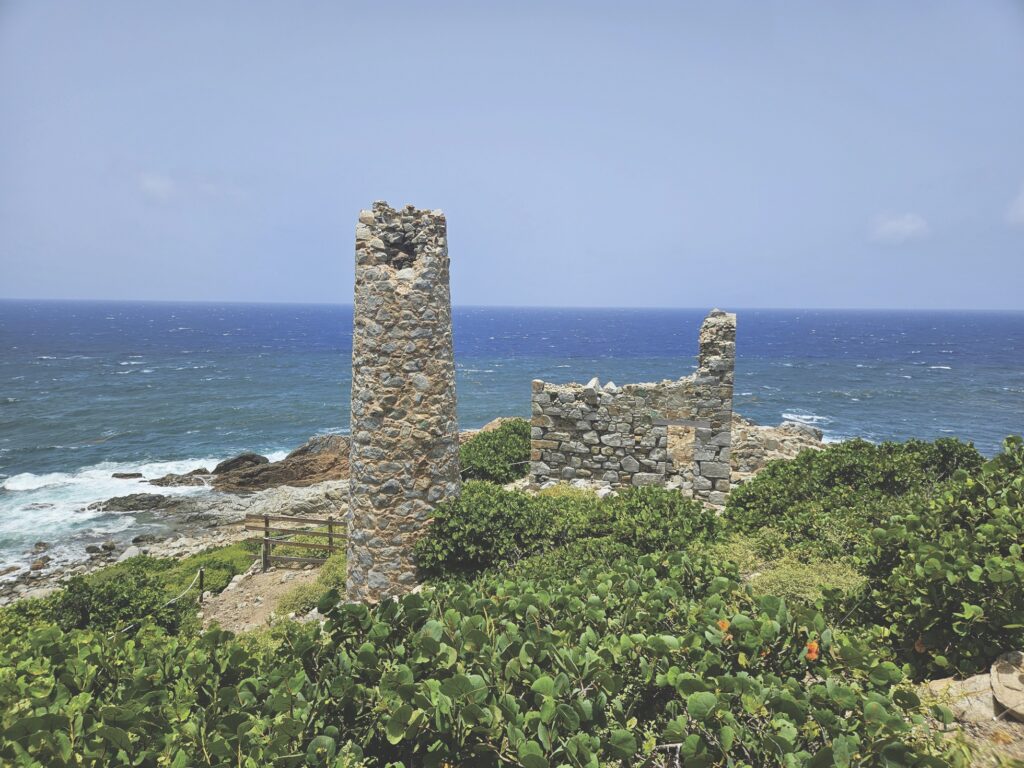
The Copper Mine National Park consists of about 18 acres. The buildings are still there having survived the catastrophic hurricanes of 2017. The engine house, chimney, mine shaft and another ruin are clearly visible and a rocky path takes you to all the vantage points. The mine shaft has been covered with a protective wire mesh for safety but you can still look down it and imagine the miners descending and working the mine some 170 years ago.
The tall chimney in a copper mine is primarily used for ventilation and emission of exhaust gases from smelting or refining processes. In Virgin Gorda’s mine the chimney was most likely used to improve the air quality in the mine and for dispersing fumes from the steam engine that was used to operate the pump that discharged water at the bottom of the mine shaft. In Virgin Gorda the ore extracted from the mine was sent to the UK, specifically Wales, where copper smelting was a recognized industry. It is doubtful that smelting ever took place on the island.
One of the notable features of the site is the remnants of a Cornish beam engine, manufactured in 1836 by the Perran Foundry in Cornwall. This engine was used for pumping out water and processing ore. The engine’s beam is reportedly lying on the beach at Handsome Bay.
Recognizing its cultural value, restoration efforts began in 1998 to stabilize the ruins, with assistance from experts in Cornwall, England. Walking around the site there is visible evidence of copper deposits in the form of malachite. Granite, feldspars and quartz can also be seen.
Beyond its historical significance, the park is characterized by granite rock formations and visible copper veins. It also serves as a habitat for white-tailed tropicbirds which nest in the cliff crevices near the engine house. The area offers panoramic views of the Caribbean Sea, making it a picturesque spot for visitors.
The Copper Mine National Park is accessible via a short drive from Spanish Town, Virgin Gorda. Visitors are advised to bring sun screen, wear sturdy footwear due to uneven terrain and to bring water. The site offers a unique blend of historical intrigue and natural beauty, making it a worthwhile destination for those exploring the British Virgin Islands.
Words by Julian Putley