
From Hillside to Harvest: The Story of Aukie’s Shanti Farm
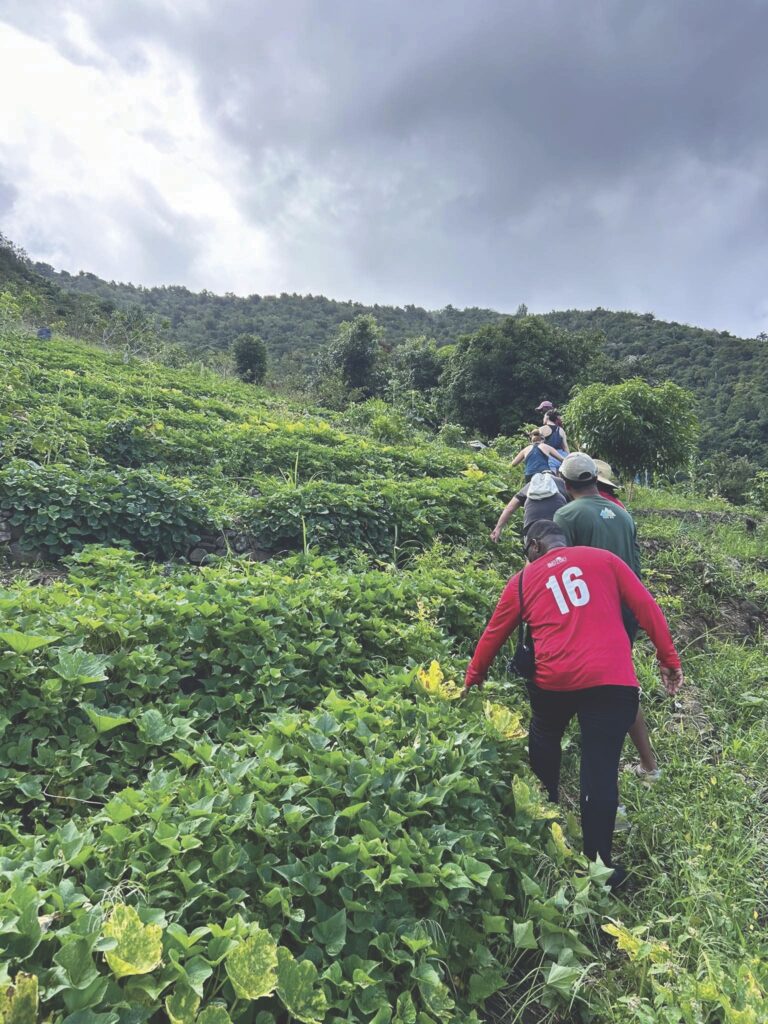
Tucked away in the lush, rugged hills of Carrot Bay—where the winding roads climb above the sleepy shores and the Caribbean Sea stretches endlessly into the horizon—lies a special place where tradition meets transformation: Aukie’s Shanti Farm.
 It’s not just a farm. It’s a living legacy, a testament to resilience, and a blossoming hub for sustainable tourism. High above the coastline, where the sun kisses the hillside and the breeze carries the scent of earth and sea, lies a patch of land rich with memory. It tells a story not just of crops and cultivation, but of hardship, rebirth, and hope.
At the heart of it all are Marley Donovan, his father Renardis Donovan, and their energetic right-hand man, Shakeem Grant. Together, this trio has transformed a once-forgotten slope into a space that’s more than rows of produce—it’s a statement. A place where the past is honoured, the present is nurtured, and the future is reimagined with every seed planted.
This is Aukie’s Shanti: a hillside farm turned haven of healing, heritage, and hope, rooted in the wisdom of generations and reaching toward a brighter tomorrow.
The Seeds of a Legacy
Before it was known as Aukie’s Shanti, the land was simply “the hill.” Unforgiving, untamed, and thick with brush, it was the kind of place most would pass by without a second thought. But to Marley and his father, it represented something more—a fresh start.
In 2017, Hurricanes Irma and Maria tore through the Virgin Islands, leaving devastation in their wake. The Donovans’ original farm, like so much else on Tortola, was completely wiped out. “We lost everything,” Marley recalls. “Years of work—gone in a few hours.”
With their fields destroyed and their livelihood disrupted, Marley and his father tried their hands at something new: fishing. “We gave it a shot,” Marley says with a grin. “But the sea just didn’t speak to us the way the soil did.” The experience made it clear—farming wasn’t just what they did, it was who they were.
They returned to the hillside, determined to start again. This time, they had a vision: not just to rebuild, but to build better.
Marley’s father, Renardis—fondly called “Aukie”—was no stranger to hardship. “He farmed through the hard days, when it was more about surviving than selling,” Marley says. “From him, I learned everything. He taught me how to read the land, how to listen to the plants, and how to respect the rhythm of nature.”
Aukie’s legacy lives not only in name, but in the farm’s very structure. Terrace farming, a technique Renardis learned from his elders, is what allows the Donovans to grow food on the steep hillsides of the BVI. “It’s not easy work,” Shakeem adds. “You’re breaking stone, carrying soil, building it bed by bed. But once you’ve carved it out, the land becomes a partner—not a problem.”


A Garden of Plenty
At Aukie’s Shanti, the hillside bursts with life. The team grows a bit of everything—bananas, plantains, sugar cane, pineapples, peppers, corn, okra, sweet potatoes, papayas, turmeric, mangoes, coconut, and tania. “We’re trying to use every inch of this hillside,” says Shakeem Grant. “And we do it with respect for the natural environment, using local materials like stones to build the terraces.”
Step onto the land and you’re greeted by an explosion of colour, scent, and sound. Sugar cane rustles in the breeze, pineapple crowns poke from the earth, and pepper plants glow red under the Caribbean sun. Rows of crops stretch across the sloping terrain like green waves, feeding both the community and the spirit.
“You name it, we probably have it somewhere,” Marley Donovan laughs. “And if we don’t, we’re probably trying to grow it.”
But life on the hill isn’t without its challenges. Water—precious and scarce in the BVI—is one of their biggest. With no natural freshwater sources on the farm, the team depends heavily on rainwater harvesting, storing every drop during the rainy season to sustain the crops through dry spells. They’ve also learned where underground wells are located in the area—a piece of knowledge passed down and shared among the older generations in Carrot Bay. It’s just one more way tradition helps them navigate the realities of the land.
Still, they’ve designed the farm not just for productivity, but for sustainability. “We use rainwater harvesting and composting. We try to keep it as organic and local as possible,” Shakeem says. “Nothing goes to waste. Even banana leaves get used as wraps or mulch.”
This is farming with intention. A living rhythm that honours the land, embraces tradition, and leans boldly into the future.
Building a Brand, Not Just a Farm
By 2019, Aukie’s Shanti had sprouted beyond its original vision. What began as a humble farming venture has become a thriving business with multiple income streams. At markets and local events, the team now sells natural juices, bush teas, smoothies, baked goods, herbal oils, spice blends, and preserves, all made from ingredients grown right on the farm.
“It’s one thing to grow food,” Marley explains. “It’s another to add value to it. That’s how you build wealth in agriculture—by creating products, not just produce.”
The venture’s branding is earthy, elegant, and deeply personal. “The name ‘Shanti’ means peace,” Shakeem shares. “And that’s what we want this place to represent. A peaceful escape, a connection to nature, and a celebration of what this land can offer.”
Tourism, Education, and the Bigger Picture
In recent years, the farm has also opened its doors to the public, offering farm tours, educational sessions, and cultural experiences. Guests can walk the terraces, sample fresh fruits, and learn firsthand about the challenges and rewards of hillside farming in the Virgin Islands.
But Marley, Shakeem, and Renardis aren’t stopping here. Their eyes are set on greenhouse expansion, renewable energy systems, eco-lodges, and even a bed-and-breakfast that allows guests to fully immerse themselves in life on the farm.
They also hope to create programmes for young farmers, offering hands-on training and mentorship. “We need to make farming cool again,” says Shakeem. “Too many young people think agriculture is outdated. But we’re here to show them it’s the future—especially if we do it right.”
A Model for the Region
What’s unfolding at Aukie’s Shanti could become a blueprint for sustainable agriculture and rural development across the Caribbean. With smart planning, community involvement, and a deep respect for ancestral knowledge, the Donovans are proving that farming isn’t just viable—it’s visionary.
“When people come here, they see the beauty,” Marley says. “But what they don’t always see is the struggle, the sweat, the heartbreak it took to get here. That’s okay. Because we didn’t do this for applause. We did it for legacy.”
More Than a Farm
In every stone laid and every crop harvested, Aukie’s Shanti carries forward the spirit of those who came before. It stands not just as a farm on a hill—but as a beacon of possibility, reminding us that even after disaster, something beautiful can grow.
So, the next time you’re in Carrot Bay, take the road that climbs upward. Follow the scent of fresh herbs, the laughter in the wind, and the call of a Mourning Dove in the distance. You might just find yourself standing in the middle of something truly special—a place where peace grows wild, and the future is always in bloom.